If Your Seal Can Be Reused, Your Security Is Already Broken
The security seal industry has a dirty little secret that doesn’t get discussed often enough.
Many organizations spend months evaluating transport providers, warehouse partners, customs procedures, tracking platforms, and risk management frameworks, only to treat the security seal itself as a commodity. Procurement compares a few specifications, negotiates pricing, places an order, and moves on.
That decision feels insignificant because the seal is usually one of the cheapest items in the entire supply chain.
Yet when a shipment goes missing, inventory doesn’t match, or an audit starts asking uncomfortable questions, that tiny piece of plastic or metal suddenly becomes one of the most important objects in the investigation.
Not because it was supposed to stop theft.
Because it was supposed to tell the truth.
And if a seal can be removed and reused without obvious evidence, then it can no longer do that.
For decades, cargo security conversations have been dominated by physical strength. Buyers ask how much force a seal can withstand. They ask about material specifications, locking mechanisms, weather resistance, and durability during transport. Those factors matter, but they often distract from the question that determines whether a seal has any real security value at all: What happens after someone decides to tamper with it?
That is where weak security products get exposed.
A seal doesn’t operate in a perfect world. It operates in warehouses during shift changes. It operates at congested ports where containers move rapidly between operators. It operates during late-night handovers, customs inspections, yard transfers, and countless moments where accountability briefly changes hands.
In those environments, the objective is not to create an impenetrable barrier. The objective is to create undeniable evidence.
There’s a difference.
The Illusion of Strength vs. The Reality of Evidence
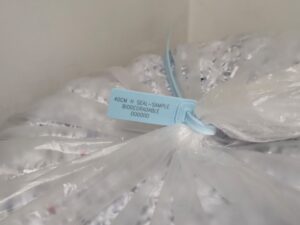
Most experienced logistics professionals understand something that newer buyers often miss: given enough time and motivation, almost any physical security measure can be defeated. Locks can be cut. Doors can be opened. Containers can be accessed.
The real test is whether the attempt leaves a trace.
That’s where reusable seals become dangerous. Not because they are physically weak, but because they introduce doubt into a process that depends entirely on certainty.
Imagine a container arriving at its destination with the seal apparently intact. Documentation matches. The seal number looks correct. Everything appears normal until a shortage is discovered during unloading.
Now the investigation begins:
-
Was the cargo removed during transit?
-
Did access occur at a warehouse transfer?
-
Was there a documentation error at origin?
-
Did someone open the container and seamlessly reattach the seal?
If the seal design allows tampering without clear evidence, every one of those possibilities remains on the table. The investigation stalls. Accountability becomes impossible to establish. Different parties start protecting their own interests rather than finding answers.
The cost of uncertainty starts accumulating immediately.
The True Price of Cheap Procurement Decisions
This is where many procurement decisions reveal their true price.
The difference between a high-quality tamper-evident seal and a questionable alternative is rarely measured by the purchase order value. It is measured by what happens when something goes wrong.
A few cents saved on a seal can disappear in minutes if a container is delayed for inspection. It can disappear even faster if a customer loses confidence in the integrity of incoming shipments. The financial impact of a disputed chain of custody logistics failure often dwarfs the savings that justified the original purchasing decision.
That’s why experienced operators evaluate seals differently from inexperienced buyers. They don’t ask whether a seal can keep a door closed—the door was already closed.
They ask whether the seal can provide credible evidence when the integrity of a shipment is questioned.
Where the Specification Sheet Fails
Sooner or later, every security system gets tested.
-
Not during a supplier presentation.
-
Not on a technical specification sheet.
-
Not in a glossy product catalogue.
It gets tested when somebody claims inventory is missing, when customs identifies an inconsistency, when an auditor requests documentation, or when a customer asks a simple question nobody wants to hear: “How do you know nobody accessed this shipment?”
At that moment, appearance becomes irrelevant. Evidence is everything.
Why Reusability and Cargo Security are Fundamentally at Odds
A reusable pallet makes sense. A reusable transport container makes sense. A reusable storage asset often improves efficiency and reduces operational costs.
A reusable tamper-evident seal creates the opposite effect.
Its entire purpose is to record an unalterable event. Once that event occurs, the evidence should be permanent. The seal should never be able to return to its original trusted state because trust is supposed to be earned through integrity, not restored through appearance.
Here’s the uncomfortable reality: a seal that can be removed, reapplied, and still appear authentic is not protecting the chain of custody. It is protecting the illusion of the chain of custody.
Those are not the same thing.
Conclusion: Show Us the Evidence
After more than a century of global trade, the fundamental requirement hasn’t changed. Customs authorities, auditors, insurers, warehouse operators, and cargo owners all want the same answer when questions arise: Show us the evidence.
Not assumptions. Not probabilities. Not explanations. Evidence.
And if a FLIMSY seal can be reused without detection, the evidence disappeared the moment the seal was compromised.
By then, the security failure has already happened. The only thing left is discovering how expensive it will become.